By Sarah Dobson
As Congress continues to shape key domestic policy priorities, two major developments are advancing that directly impact our network: the implementation of the budget reconciliation law and renewed bipartisan momentum on federal housing legislation. Each presents challenges and opportunities for engagement. Below, we provide updates on what’s unfolding, how your input is essential, and where we’re focusing our advocacy efforts in the weeks ahead.
Budget Reconciliation: Implementation Timeline and Feedback on Impacts
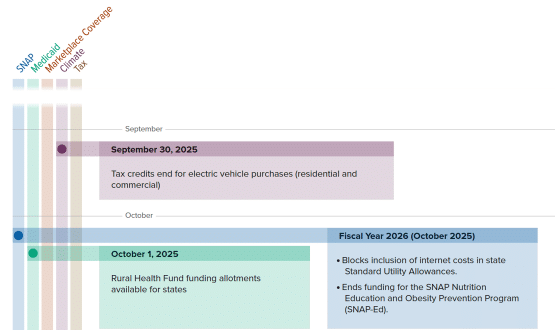
Following the enactment of the sweeping budget reconciliation law on July 4, our policy and advocacy focus has turned to the effects of its implementation, with much of the impact depending on which state is being discussed. For example, the Kaiser Family Foundation has prepared a state-by-state analysis of the impact of Medicaid spending reductions. Further, many of the law’s provisions do not take immediate effect, instead rolling out over the course of the next five years. The Center on Budget and Policy Priorities has prepared a helpful interactive timeline showing the various effective dates. Click on the snapshot below to view the full timeline.
In addition, in order to most effectively communicate the impact on our network of healthcare related changes in the law, we are asking for your feedback on a brief series of related questions. We realize not all questions will be relevant to everyone in our network—feel free to respond to only those questions that relate to your organization. Sample questions include: “What changes included in the law do you consider to be the highest priority for your organization to address?” and “Have you completed any analysis about how the law will impact your community?”
SHARE HOW BUDGET RECONCILIATION WILL IMPACT YOU
Thank you for your ongoing engagement with us in raising our unified faith-based voice with lawmakers and administration stakeholders. We will continue tracking both implementation of the current law and further legislative efforts carefully and will update you as needed.
Bipartisan Senate Housing Bill Moves Forward
On July 29, the Senate Committee on Banking, Housing, and Urban Affairs held a unanimous vote to pass the bipartisan “Renewing Opportunity in the American Dream (ROAD) to Housing Act” (S. 2651) out of committee. This is the first bipartisan housing bill markup in over a decade, following introduction of the legislation by committee chair Tim Scott (R-SC) and ranking member Elizabeth Warren (D-MA.) The ROAD to Housing Act includes 40 provisions that cover financial literacy, housing supply, manufactured housing, homeownership, program reform, veterans’ housing, and oversight and coordination of housing program and agencies.
Related to specific housing policy priorities of our network, the bill includes:
- the provisions of the Rural Housing Service Reform Act, bipartisan legislation that would improve federal rural housing programs, cut red tape, and strengthen the supply of affordable housing by improving and strengthening several Department of Agriculture rural housing programs
- reauthorization and improvement of the Home Investment Partnerships Program (HOME); creation of a competitive pot of highly flexible funding for communities that can be used to support affordable or mixed-income housing
- a requirement for interagency coordination between the Department of Housing and Urban Development, USDA, and the Department of Veterans Affairs for the purposes of sharing data, streamlining processes, and increasing collaboration
Senators from both parties acknowledged the potential impact of recent substantial cuts at HUD on the future success of the bill but affirmed their support for moving forward. We anticipate that the House will hold a committee markup on the legislation this fall, and we will be tracking its progress and updating accordingly as we advocate for inclusion of additional needed provisions.
For more information, please contact Sarah Dobson, senior director of public policy and advocacy.