

CMS Issues Initial Guidance on Medicaid Work Requirements

December 11, 2025

On December 8, the Centers for Medicare and Medicaid Services (CMS) issued initial, new guidance to states to inform implementation of the new Medicaid community engagement provisions (aka: work reporting requirements) included in H.R. 1.  The new law includes multiple sweeping changes to the Medicaid program, with more guidance expected to follow.  In issuing this initial guidance, CMS officials outlined four principles guiding policy development:  

  1. connect members to work and community;
  2. offer states flexibility;
  3. promote alignment with existing requirements for other programs such as SNAP and TANF; and
  4. protect taxpayers. 

CMS reiterates the statutory deadline of January 1, 2027, for states to implement the new community engagement requirements, while outlining a process for the Secretary to grant temporary compliance exemptions ending on December 31, 2028 or before to states experiencing hardships but demonstrating good faith efforts to comply.  The agency will also issue grants to help states establish new or updated systems to comply with the new requirements.   

What’s New?

While the guidance focuses primarily on restating in plain language the requirements from H.R. 1 across key areas of focus, as enumerated below, there are a few new pieces of operational direction as noted.  For example, CMS has offered new interpretations related to compliance verification, potential sources of “reliable information” for those verifications, and the role of managed care organizations (MCOs).  Deeper analysis is also available from our partners in the Modern Medicaid Alliance.   

Applicable individuals: 

  • Only individuals who are 1) aged 19-64, not pregnant, not eligible for or enrolled in Medicare, and not eligible for Medicaid via other mandatory group; or 2) eligible to enroll in Medicaid under a waiver and who meet the first set of criteria.  
  • NEW in this guidance: CMS clarifies that the requirements will NOT apply to states that 1) have not expanded Medicaid AND 2) do not have a 1115 waiver offering minimum essential coverage (MEC); and 
  • Looking ahead: CMS notes that it will continue to evaluate which existing state section 1115 demonstration populations meet the definition of an “applicable individual.” 

Activities which meet the community engagement requirements (per month): 

  • 80 hours of work 
  • 80 hours of community service 
  • 80 hours of work program participation 
  • 40 hours of enrollment in an educational program 
  • A combination of 80 hours in any of the above 
  • A monthly income not less than $580 
  • Seasonal work with average monthly income over the preceding 6 months of not less than $580 

Exclusions to the requirements: 

  • Former foster youth up to age 26 
  • A person who is an Indian (including Urban Indian, California Indians, or individuals otherwise determined eligible as Indians for the Indian Health Service) 
  • A parent, guardian, or caretaker relative of a disabled individual or dependent child under the age of 13 
  • A veteran with a total disability rating 
  • A person who is medically frail or otherwise has special medical needs 
  • A person who is complying with any requirements under the SNAP program or who is a member of a household that receives SNAP and is not exempt from work requirements 
  • Participants in drug addiction or alcoholism treatment and rehabilitation programs 
  • Inmates of public institutions 
  • Individuals who are pregnant or entitled to postpartum medical assistance 
  • NOTABLE in this guidance: CMS opted NOT to include the definition of “medical frailty” as described in the legislation in this initial guidance.  

Exceptions to the requirements for individuals experiencing short-term hardships including: 

  • Receiving various types of inpatient services 
  • Residing in a county in a state of emergency or disaster or in a state with a high level of unemployment 
  • Having to travel for an extended period to receive medical services unavailable at home 

Demonstrating and verifying compliance:  

  • New applicants must demonstrate compliance for one or more (not more than three) consecutive months immediately preceding the month of application 
  • Current enrollees must demonstrate compliance for at least one or more months during the period between the previous eligibility determination and the next redetermination 
  • NEW in this guidance: 
    • Beneficiaries are considered compliant if they demonstrate compliance during any part of the eligibility period, and states may not require compliance in specific or consecutive months. 
    • States must conduct redeterminations every six months for expansion populations. 

Use of reliable information:  

  • States are required to establish a process and first attempt to use reliable information available to them without requiring an individual to submit additional information to verify compliance 
  • NEW in this guidance 
    • CMS expands on potential sources of such reliable data 
    • The agency adds that states may not request additional information or documentation from individuals unless they are unable to establish compliance using reliable data.  

Non-compliance procedures when states cannot verify compliance: 

  • States must issue a notice of noncompliance and provide 30 calendar days to demonstrate compliance or qualification for exemption or exception. 
  • For current enrollees, states must continue to provide coverage during this 30-day period. 
  • In all cases, if compliance is not demonstrated, the state must deny coverage or disenroll the individual at the end of the month following the month in which the 30-day period ends. 

Outreach: 

  • States must notify beneficiaries about the requirements before they are implemented and periodically thereafter. 
  • States have a set period to begin outreach, and the outreach must be sent by mail and at least one additional method. 

Role of Managed Care Plans (MCOs):  

  • NEW in this guidance: states cannot permit MCOs to decide whether beneficiaries are compliant, but MCOs may perform supportive tasks.

What’s the Takeaway? 

CMS is expected to issue additional guidance, particularly with more detailed instructions for state operationalization.  H.R. 1 requires CMS to issue an interim final rule by June 1, 2026, though it is not yet clear whether outstanding questions will be addressed through that final rulemaking or through further subregulatory guidance beforehand. We will share more information as it becomes available.

Sarah Dobson is Senior Director of Advocacy and Public Policy at Lutheran Services in America.

Celebrating National Disabilities Independence Day

July 26, 2022

Thirty-two years ago today, President George H. W. Bush signed the Americans with Disabilities Act into law. The passing of the ADA was a landmark event that prohibits discrimination against people with disabilities across the country.

The ADA’s passage was a momentous occasion that advanced the cause for equal opportunity for millions. Three decades later, we continue to take steps forward to ensure that people with disabilities have access to services and supports that are critical for maintaining a life of independence, dignity and respect.

For many people living with disabilities, funding and other support is incredibly helpful in preserving their quality of life. For Deb, assistance in making improvements to her house was vital. With the help of additional resources, Deb worked with her service provider Gretchen at our member Mosaic to make the necessary updates to her home to meet her needs. Deb’s story is one of inspiration and success. “I feel so independent,” she said.

All people deserve the opportunity to live abundantly and independently. Additional resources are required for accessible housing and long-term services and supports for those who need them. The path to improved services includes a broad approach to address the challenges facing the disability community. Strengthening the direct care workforce and expanding home- and community-based services are a must. But we must also take care to shore up the financial security and independence of those receiving care while expanding civil rights and protections.

In taking these approaches, our nation can make the investment needed to lift up the direct care workforce and provide equal opportunity to people with disabilities to realize their potential.

Learn more about our work to champion services for people with disabilities.

Lutheran Services in America Study Demonstrates Scalability of Innovative Transition Care Practices

June 24, 2021

Lutheran Services in America co-authored a study published in April by the medical journal Geriatric Nursing on the impact of our Connect-Home learning collaborative’s implementation of the innovative care transition intervention for older adults in post-acute care. Connect-Home was developed by Dr. Mark Toles at the University of North Carolina at Chapel Hill. The findings of this study demonstrate the scalability of innovative transition care practices that retrain post-acute care workers and proactively address social determinants of health to improve the quality of care for older adults.

For details, find the study in our Connect-Home resource library.


Families First Coronavirus Response Act Signed Into Law

March 20, 2020

On March 18, President Trump signed into law the Families First Coronavirus Response Act, legislation which aims to provide economic relief for individuals, businesses, and organizations impacted by COVID-19, including Lutheran Services in America member organizations. Among its other provisions, the law provides increased federal support for Medicaid spending during the pandemic in the form of a 6.2% emergency Federal Medical Assistance Percentage (FMAP) increase to states. The FMAP is the federal portion of the total Medicaid expenditure for each state.

The law also institutes a temporary paid sick leave mandate, along with an expansion of family and medical leave provisions. Employers with fewer than 500 employees, including nonprofits, will be required to provide employees who are themselves sick or quarantining two weeks of fully paid sick leave, and 10 additional weeks of leave at two-thirds pay. Employees caring for others who are sick or children whose childcare services are closed must be paid at two-thirds of their regular pay for up to 12 weeks. Employers will be fully reimbursed for providing this leave via a refundable tax credit allowed against the employer portion of payroll taxes—thus benefitting nonprofits. Any paid leave costs that exceed the amount of payroll taxes owed will be refundable to the employer at the end of each quarter. Finally, the law suspends SNAP work requirements and provides free testing for COVID-19, $2 billion in unemployment assistance and $1 billion in food aid.

Another relief bill is currently being written in Congress, which is expected to include additional specific support for the nonprofit sector and individuals and families.

UPDATE: Coronavirus Aid, Relief and Economic Security Act Signed into Law

March 26, 2020

Over 600 Lutheran Services in America member representatives reach out to Congress.

UPDATE: On March 27, 2020, President Trump  signed this bill into law.

On March 25, 2020, the U.S. Senate voted unanimously to approve the Coronavirus Aid, Relief and Economic Security Act (H.R. 748), a $2.2 trillion package meant to address the coronavirus pandemic and its impact on the economy. This is the third and by far the largest to date in what is expected to be a series of additional such relief measures. A vote in the House of Representatives is expected on Friday (3/27) to finalize this legislation.

Particularly important for Lutheran Services in America members, the package makes available forgivable loans for small business with less than 500 employees per location that can be used to cover payroll support, such as employee salaries, paid sick or medical leave, insurance premiums, and mortgage, rent, and utility payments. The package also creates a low-interest loan program that can be used for larger nonprofits who employee between 500 and 10,000 employees. (Additional key details to come shortly.)

Over 600 Lutheran Services in America member representatives sent nearly 1,150 messages to their Senators and Representatives, at all hours of the day and night, calling for nonprofit organizations to be included in this relief package. This priority outreach from so many people in our network made an enormous difference, and we heartily thank everyone for their vital efforts and action during this critical time!

While this legislation is an important step forward, we emphasize that much work remains to help ensure that health and human service agencies working on the frontlines of this crisis have access to the equipment, supplies, and funding they need to help carry out their work helping so many people each day. Lutheran Services in America will continue to work closely with our federal partners in the coming days and months to help ensure the needs of our members and the people they serve are front and center.

We issued a statement shortly after the Senate vote, in which we emphasized these loans are a “crucial part of this third Congressional relief package, given how many nonprofits like our 300 health and human services organizations are on the frontlines fighting COVID-19.” You can read the full statement here.

Lightning Rod for Change: Our Push to Fund the Frontlines

May 18, 2020

As the coronavirus pandemic stretches our nation’s health system to its limits, the importance of America’s human service professionals has never been more cut and dried. However, nonprofits cannot effectively serve their communities without adequate financial relief or resources from Washington. After more than two months of challenging work, human service professionals are united in telling Congress, “Fund the frontlines!”

As the national office of a sprawling network of more than 300 nonprofit health and human service organizations, Lutheran Services in America is using the collective calls for financial support from members as a springboard for changes in federal and state policy. By channeling these concerns about limited resources into the basis for advocacy efforts, we have been successful in communicating to lawmakers the needs of nonprofits and their workers who are fighting on the front lines of this deadly pandemic. Since March, Lutheran Services in America has worked to secure key priorities in coronavirus relief packages, including:

  • Access to financial relief for health and human service nonprofits with more than 500 employees via forgivable loans
  • Targeted financial resources for nonprofit frontline health and human services providers to cover unreimbursed expenses related to the pandemic
  • Reimbursement of the cost of unemployment insurance benefits paid by nonprofits who self-fund these benefits
  • Funding for vulnerable youth and children through the Child Abuse Prevention and Treatment Act and Title IV-E Chafee funds

These outstanding priorities are in addition to some steps we have already taken to address our members’ most prominent needs and concerns. We sought to relieve some of the burden related to business continuity by advocating for the Medicaid exemption with the CARES Act to be removed. We sought new partnerships to help with accelerated entry into the workforce and connected members to personal protective equipment supply networks.

We are also addressing the concerns from our membership through proactive methods in several other key areas. The expanded reliance on technology has opened up new opportunities for facilitating peer-to-peer sharing of news, resources, and insights. The exchange of information about adopting new protocols for residents, addressing employee morale, and other means of combating the COVID-19 strengthens the network’s ability to weather the storm of this unprecedented challenge.

Despite this tremendous progress, there is still much more to be done. We must double our efforts to protect the workforce of nonprofit health and human services organizations as they face narrowing revenue streams amidst a sliding economy. We need to ensure facilities are able to hire new staff quickly and safely at a time they are needed more than ever. We strive to address these challenges every day, and will continue to do so once this global crisis has abated. As Congress considers its next moves to help support the nation, we will push lawmakers and regulatory agencies any way we can to ensure nonprofits receive the resources they need to serve some of our most vulnerable populations.

We are not doing this alone. Lutheran Services in America keeps members informed through regular updates, action-oriented advocacy alerts, and an extensive library of resources, but the dedicated professionals working within our 300-member organization network are the driving force behind any change. We thank all of our members for your courageous efforts. You are on the front lines making a difference to so many every day. Together, we will continue to fight for funding for front line workers who risk their lives every day on behalf of the rest of us.

House Recognizes Nonprofit Priorities in Latest COVID-19 Bill

May 19, 2020

The House of Representatives passed a $3 trillion coronavirus relief package last Friday to help mitigate the disastrous effects of the pandemic. Lutheran Services in America has been a vocal advocate for the inclusion of nonprofits in any new aid packages. Our national network of health and human service organizations rallied to collectively voice support for our key priorities, which include some of the vital resources enumerated in the Health and Economic Recovery Omnibus Emergency Solutions (HEROES) Act — a bill that builds on the work of previous relief bills by including support for nonprofit organizations.

Thanks to the engagement of our members, we are pleased to see the bill addresses some of our most important priorities, including access to financial relief for health and human service nonprofits with more than 500 employees, and targeted financial resources for nonprofit frontline health and human services providers. The fulfillment of these priorities would grant nonprofits the funds and resources necessary to offer the care and service needed by many Americans during this critical time. While the HEROES Act is a welcome show of support for nonprofits in the House, there is still much work to do to gain similar support in the Senate in order to sustain our network’s crucial work.

Today’s Front Line Hero: Advocate Aurora Health

May 26, 2020

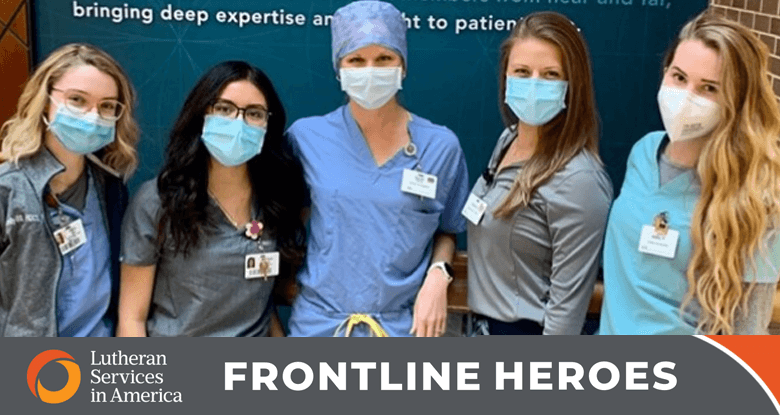
Today’s Front Line Hero is Advocate Aurora Health for their research contributions, adding to academic knowledge about the novel COVID-19 virus.

A team of 5 cardiac sonographers at Aurora St. Luke’s Medical Center have been working on the front lines during COVID-19, and recognized that ICU procedures to detect impacts of the virus on the heart were inefficient. The team started investigating how the virus affects the heart by personally scanning patients in the COVID-19 ICU. They developed an innovative new procedure that is more targeted, and more accurately identifies deadly symptoms. The new procedure collects better patient data faster, improving patient care and limiting the exposure of caregivers. The Advocate team published their findings, and are writing the worldwide standard for treating COVID-19 patients with cardiac systems.

Advocate Aurora Health researchers are also contributing to efforts to better understand COVID-19 outcomes for cancer patients. An Advocate researcher co-authored a recent study, and will release early data on outcomes for cancer patients at the upcoming virtual American Society of Clinical Oncology conference. The consortium of cancer researchers crowdsourced the data, allowing for speed in releasing the results of the study.

Thank you to Advocate Aurora Health for your dedication to serving patients during the COVID-19 pandemic, and for your work contributing to the global understanding of the novel virus.

HHS Publishes Lutheran Services in America Article on Transforming Child Welfare

August 19, 2020

The official e-magazine for the Department of Health and Human Services’ Administration for Children and Families published an article by Lutheran Services in America’s Sheila Weber about how the intersection of several devastating realities in our society are having a disparate impact on Black people, indigenous populations, and people of color in America, particularly children. Part of the solution to this issue involves shifting our thinking from how to protect children in families that are in crisis to creating societal conditions that equitably protect and strengthen families.

Lutheran Services in America’s Results Innovation Lab is activating our members serving children, youth, and families to stabilize families in their communities so that families remain intact and children do not enter out-of-home care. Furthermore, we are calling for much-needed state and federal investments in primary prevention efforts that strengthen families’ protective capacities and factors.

Read the complete article published by Children’s Bureau Express (CBX).

Nonprofits Must Have Support in New Economic Recovery and Infrastructure Package

May 4, 2021

Congress is currently preparing an economic recovery package based on the “American Jobs Plan” proposed by President Biden to improve America’s physical and social infrastructure and help move the economy forward and out of the COVID-19 pandemic.  Lawmakers are negotiating with the Administration and crafting the legislative language for this bill now.

While details of what will be included in the final bill are subject to change as the process moves forward, we are asking Members of Congress to support the following significant provisions for our network currently being considered:

  • $400 billion for home and community-based services (HCBS) for older adults and persons with disabilities.  This unprecedented investment in these services could enable health and human services providers to expand services and eliminate the nationwide waitlist of 850,000 older adults and persons with disabilities so they can receive needed services in their homes and communities. This could also help address the workforce shortage, for example, through increased wages and benefits for direct care workers. Finally, it would allow expansion of the Money Follows the Person program and for older adults transitioning from acute care setting to their homes to receive the services needed to prevent rehospitalization such as transportation, nutrition, and more.
  • $213 billion for affordable housing and homelessness services to produce, preserve, and retrofit more than two million affordable and sustainable places to live, address longstanding public housing capital needs, and eliminate exclusionary zoning and harmful land use policies.
  • Inclusion of the provisions of the WORK NOW Act (S. 740): this $50 billion grant program will provide nonprofit health and human services organizations funding to pay wages, salaries and benefits to retain staff, meet the greater demand for services, and hire unemployed workers.

More information can be found in our detailed summary.

Join us by sending a message to lawmakers: please support provisions currently under consideration which would benefit nonprofit health and human services providers. While we will continue to advocate that ALL our crucial priorities for further support for nonprofits be enacted, it’s important for lawmakers to hear our voice now as they prepare the current legislation.

Supporting
Our Neighbors,

TOGETHER.

Our shared Lutheran tradition of service to our neighbor is more vital than ever.

Join us as we work to ensure our network continues delivering essential services to all in need.